
CMHC MLI Select Alberta: A Practical Guide for 5+ Unit Buyers
Learn how CMHC MLI Select works for existing rental properties and new construction in Alberta—including the point system, NOI, DCR, LTV, LTC, cash requirements and the buyer process from pre-screening to closing.
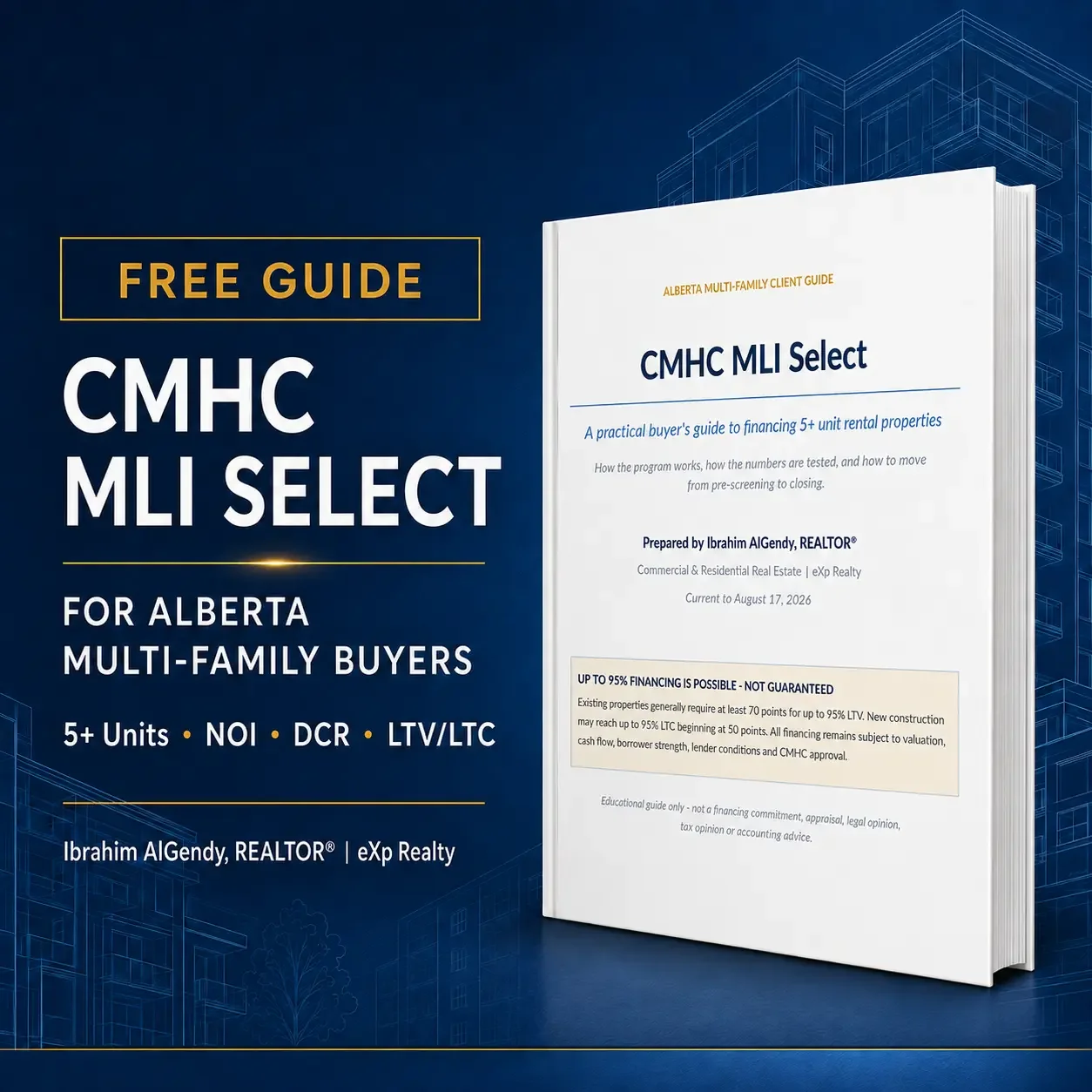 Free PDF • 14 pages
What is CMHC MLI Select?
MLI Select is CMHC mortgage loan insurance for qualifying multi-unit rental housing. It rewards commitments to affordability, energy efficiency and accessibility through a points system that can unlock higher leverage, longer amortization and reduced insurance premiums.
Most eligible projects require at least five residential rental units.
Better terms may become available as qualifying commitments increase.
Depending on project type, points, valuation, income and underwriting.
At 100 points and never beyond the property’s remaining economic life.
A qualifying transaction may reach high leverage, but the final loan can still be limited by CMHC-accepted value or eligible cost, NOI, DCR, borrower strength, guarantees, property condition, remaining economic life and lender conditions. Five per cent may be the base equity calculation; it is not necessarily the complete cash-to-close budget.
Project and borrower eligibility
MLI Select can apply to both existing properties and new projects, but the asset, borrower and proposed commitments must all fit the program and the Approved Lender’s underwriting.
Eligible project profile
- Minimum five rental units in most cases.
- Existing purchases, refinances and new construction may qualify.
- Standard rental, SRO, supportive and retirement housing can be eligible.
- Student housing can qualify through energy efficiency and accessibility.
Mixed-use limits
- Non-residential space generally cannot exceed 30% of gross floor area.
- It also cannot exceed 30% of total lending value.
- The non-residential loan component has separate leverage limits.
- Property use, zoning and leases must support the application.
Borrower screen
- Substantiated net worth, liquidity and source of equity.
- Relevant management experience or a professional third-party manager.
- Acceptable ownership, guarantor and covenant structure.
- Creditworthiness and the complete borrower file are reviewed.
Credit still matters, but CMHC’s current public MLI Select materials focus on the complete borrower, guarantor, property and lender file. A single score should not be treated as a financing commitment.
How the MLI Select point system works
A project can focus on one outcome or combine affordability, energy and accessibility commitments. A minimum of 50 points is required to qualify for MLI Select.
Affordability
Measured using rents at no more than 30% of CMHC median renter income for the applicable market.
- Existing: 40% / 60% / 80% of units for 50 / 70 / 100 points.
- New: 10% / 15% / 25% of units for 50 / 70 / 100 points.
- Minimum 10-year commitment.
- A 20+ year commitment earns 30 additional points.
Energy efficiency
Requires qualifying improvement beyond the applicable existing-building baseline or national building-code baseline.
- Existing: 15% / 25% / 40% reduction for 20 / 35 / 50 points.
- New: performance is tested against the applicable NECB or NBC framework.
- Qualified professional modelling and evidence are required.
Accessibility
Uses visitability, barrier-free common areas, accessible units, universal design or recognized certification.
- 20- or 30-point paths are available.
- All units must be visitable for accessibility points.
- Common areas must meet the applicable barrier-free standard.
- An architect or accessibility consultant supports the commitment.
| Project and points | Maximum leverage | Maximum amortization | Standard rental DCR | Recourse |
|---|---|---|---|---|
| Existing — 50 points | Up to 85% LTV | Up to 40 years | Minimum 1.10 | Full |
| Existing — 70 points | Up to 95% LTV | Up to 45 years | Minimum 1.10 | Full |
| Existing — 100 points | Up to 95% LTV | Up to 50 years | Minimum 1.10 | Limited recourse may be considered |
| New construction — 50 points | Up to 95% LTC | Up to 40 years | Minimum 1.10 | Full |
| New construction — 70 points | Up to 95% LTC | Up to 45 years | Minimum 1.10 | Full |
| New construction — 100 points | Up to 95% LTC | Up to 50 years | Minimum 1.10 | Limited recourse may be considered |
These are program ceilings. Amortization cannot exceed remaining economic life. Other shelter models and non-residential space use higher DCR requirements. Verify the current terms, premiums and lender overlays for the specific application.
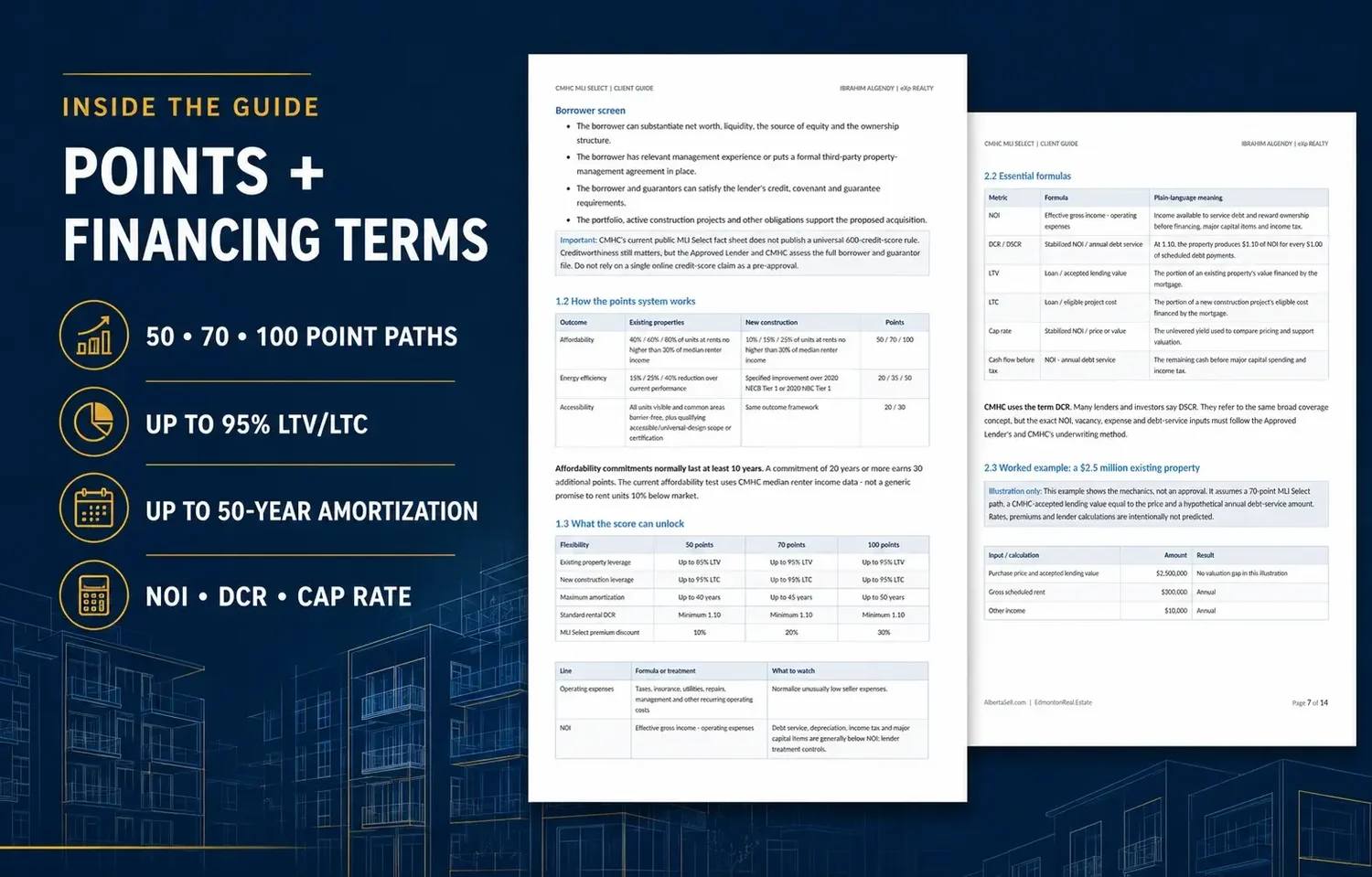
The numbers that determine the loan
High leverage does not replace strong property economics. The lender and CMHC normalize income and expenses, establish an acceptable lending value and test whether the resulting NOI can support the requested debt.
NOI
Net Operating Income is the stabilized income remaining after vacancy and recurring operating expenses, but before debt service, major capital items and income tax.
Effective gross income − operating expensesDCR / DSCR
Debt Coverage Ratio tests whether NOI can cover scheduled mortgage payments. At 1.10, the property produces $1.10 of NOI for each $1.00 of annual debt service.
Stabilized NOI ÷ annual debt serviceLTV
Loan-to-Value measures the mortgage against CMHC-accepted lending value for an existing property—not necessarily the price written in the offer.
Loan ÷ accepted lending valueLTC
Loan-to-Cost measures a new-construction mortgage against eligible project cost. Ineligible costs and cost overruns still require separate cash.
Loan ÷ eligible project costCap rate
The capitalization rate is an unlevered yield used to compare pricing and support valuation. It should be calculated from stabilized NOI, not gross rent.
Stabilized NOI ÷ price or valueCash flow
Cash flow before tax shows what remains after scheduled debt payments, before major capital spending and income tax.
NOI − annual debt serviceThe broad concept is the same, but the exact vacancy, expense, NOI and debt-service inputs must follow the Approved Lender’s and CMHC’s underwriting method.
A $2.5-million existing-property example
This simplified example demonstrates the mechanics. It assumes a 70-point path, an accepted lending value equal to the purchase price and a hypothetical annual debt-service figure. It is not a quote or approval.
| Input or calculation | Amount | Explanation |
|---|---|---|
| Purchase price and accepted value | $2,500,000 | No valuation gap in this illustration |
| Gross scheduled rent | $300,000 | Annual |
| Other income | $10,000 | Annual |
| Vacancy and credit loss | ($15,500) | 5% of gross rent plus other income |
| Effective gross income | $294,500 | $310,000 less $15,500 |
| Operating expenses | ($119,500) | Annual normalized expenses |
| Stabilized NOI | $175,000 | $294,500 less $119,500 |
| 95% LTV ceiling | $2,375,000 | $2,500,000 × 95% |
| Base equity | $125,000 | Before closing and other cash requirements |
| Hypothetical annual debt service | $150,000 | Illustration assumption |
If the property costs $2.5 million but the accepted lending value is $2.4 million, a 95% LTV ceiling produces a maximum base loan of $2.28 million. The buyer’s price contribution becomes $220,000 before closing costs, insurance-related amounts, reserves and capital requirements—not $125,000.
The approved loan is usually the lowest of three limits
Valuation limit
The permitted LTV applied to CMHC-accepted lending value.
Income limit
The loan amount whose debt service can be supported by underwritten NOI and the required DCR.
Risk limit
The amount accepted after reviewing the borrower, guarantees, market, property condition and all conditions.
From strategy to closing: the 10-step buyer process
The cleanest MLI Select files are planned before the offer. The buyer, REALTOR®, Approved Lender, mortgage specialist, lawyer, accountant, property manager and technical consultants should work from the same acquisition assumptions.
Assemble the team early
Identify the Approved Lender or specialist, buyer’s representative, lawyer, accountant and property manager. Add appraisal and technical professionals as required.
Complete a borrower pre-screen
Organize net worth, liquidity, source of equity, ownership, guarantors, tax records, credit, portfolio results and management experience.
Choose a realistic scoring path
Model affordability, energy and accessibility commitments with the lender and qualified consultants before relying on projected points.
Set the acquisition box
Define market, unit count, price, target NOI, capital work, required cash flow, scoring route and total available liquidity.
Screen each property
Review the rent roll, operating statements, preliminary NOI/DCR, value range, economic life, capital needs and commitment fit.
Write a properly conditional offer
Use a realistic financing condition and adequate due-diligence access. An early quote is not final MLI Select approval.
Complete due diligence
Verify leases and income, inspect condition, review title and zoning, commission required reports and resolve discrepancies before waiver.
Lender underwrites and submits
The Approved Lender validates the borrower, property and MLI Select evidence and submits the insurance request to CMHC.
Satisfy approval and closing conditions
Finalize guarantees, insurance, legal documents, equity evidence, commitments, holdbacks and required repairs or reports.
Maintain the commitments
Keep affordability compliance records and complete energy and accessibility evidence within the applicable timelines after closing.
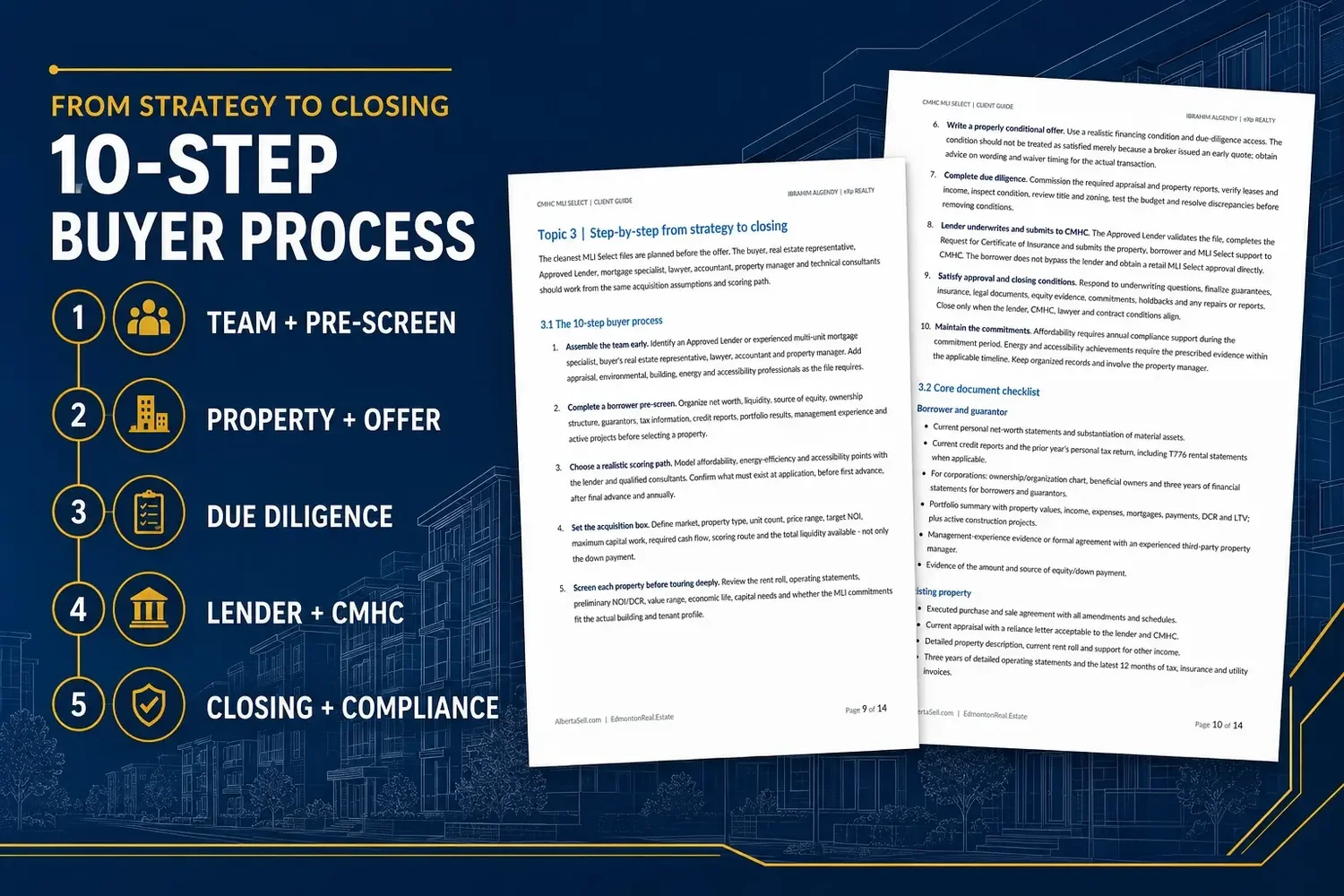
Core MLI Select document checklist
Documentation depends on the borrower, project and commitments. Use this as an early planning list—not a substitute for the lender’s transaction-specific checklist.
Borrower and guarantor documents
- Current personal net-worth statements and support for material assets.
- Current credit reports and applicable personal tax returns.
- Corporate ownership chart, beneficial owners and financial statements where applicable.
- Portfolio summary covering values, income, expenses, mortgages, DCR and LTV.
- Management-experience evidence or a formal professional property-management agreement.
- Evidence of the amount and source of equity.
Existing-property documents
- Executed purchase agreement with amendments and schedules.
- Current appraisal and lender-acceptable reliance.
- Detailed property description, rent roll, leases and support for ancillary income.
- Three years of operating statements plus current tax, insurance and utility support.
- Repairs and capital plan with applicable reports or quotations.
- Environmental, building-condition, zoning, title and other asset-specific due diligence.
New-construction or major-work documents
- Detailed construction budget, land, hard and soft costs, contingency and taxes.
- Plans, specifications and construction contract or management structure.
- Quantity-surveyor and progress-advance support when required.
- Pro forma rent roll, market support, feasibility and lease-up assumptions.
- Energy and accessibility attestations, modelling and professional support.
MLI Select commitment evidence
- Affordability: rent roll proving qualifying unit count and rent limits, plus the compliance plan.
- Energy: signed commitment or attestation and qualified-professional modelling or certification.
- Accessibility: signed architect or consultant attestation, unit counts and visitability/barrier-free support.
Do not treat a preliminary financing conversation as final approval. Where financing is essential, preserve an appropriate condition until the buyer has the written approvals and information needed to make an informed waiver decision. Exact clause wording and timing require transaction-specific real estate and legal advice.
Common mistakes to avoid
A strong MLI Select file is built on supportable income, realistic expenses and evidence—not only a high-leverage headline.
Assuming every project needs only 5% down
Points, value, NOI, DCR and underwriting can all reduce the loan or increase the cash required.
Using gross rent for cap rate
Cap rate should be calculated using stabilized NOI after realistic vacancy and operating expenses.
Accepting the seller’s pro forma
Future rents, missing management costs and unusually low repairs need evidence and normalization.
Ignoring the valuation gap
A purchase price above accepted lending value can produce a much larger equity requirement.
Removing conditions too early
A broker indication is not a lender commitment, CMHC decision or completed due-diligence review.
Forgetting post-closing compliance
Affordability, energy and accessibility commitments require records and evidence after funding.
MLI Select still starts with the right property
Financing cannot repair a weak acquisition. Location quality, rent durability, supply risk, building condition, capital requirements and exit flexibility remain important even when high leverage may be available.
Alberta multi-family
Explore opportunities across the province and compare location, unit mix, asking price and investment fit before beginning detailed underwriting.
Browse Alberta multi-family properties →Edmonton multi-family
Review Edmonton opportunities with attention to neighbourhood quality, rental demand, future supply, operating history and building condition.
Browse Edmonton multi-family properties →Calgary multi-family
Explore Calgary opportunities and test rents, expenses, cap rate, construction risk and long-term positioning against the investment plan.
Browse Calgary multi-family properties →CMHC MLI Select Alberta FAQ
These answers provide general orientation. The Approved Lender and professional advisors must confirm the requirements for each borrower and property.
Can I really buy a 5+ unit property with 5% down?
Qualifying transactions may reach a 95% LTV or LTC program ceiling, but that does not guarantee a 5% total cash requirement. Accepted value, eligible cost, NOI, DCR, closing costs, premiums, repairs, reserves and lender conditions can require substantially more cash.
How many units does an MLI Select property need?
Most eligible multi-unit projects require at least five rental units. Retirement housing generally requires at least 50 units or beds, and additional property-specific requirements apply.
Can MLI Select finance both existing properties and new construction?
Yes. Existing properties and new construction can qualify, but their affordability scoring, leverage calculation, documentation and construction-risk requirements differ.
Does CMHC publish a universal minimum 600 credit score?
CMHC’s current public MLI Select fact sheet does not state a universal 600-score rule. Creditworthiness remains important, but the lender and CMHC assess the complete borrower, guarantor, property and application.
Do I apply directly to CMHC?
No. The Approved Lender underwrites the file and submits the mortgage-loan-insurance request and supporting MLI Select documentation to CMHC.
How long does MLI Select approval take?
There is no universal public approval-time guarantee. Timing depends on file completeness, appraisal and report availability, ownership complexity, scoring evidence, lender review, CMHC questions and outstanding conditions.
Should my purchase offer include a financing condition?
When financing is essential, the offer strategy should normally preserve appropriate protection until the necessary written approvals and information are available. The wording and timing must be prepared for the specific transaction with the buyer’s REALTOR® and lawyer.
Can a non-Canadian buyer use MLI Select?
Do not rely on a blanket rule. The federal prohibition on certain residential purchases by non-Canadians, ownership structure, exemptions, lender policy and CMHC eligibility must be reviewed for the actual buyer and asset with qualified legal and financing advisors.
Official CMHC sources
Program terms can change. Re-check the current CMHC materials and the Approved Lender’s requirements before relying on a point score, loan amount or timeline.